

The Shrine's Story
How It All Started
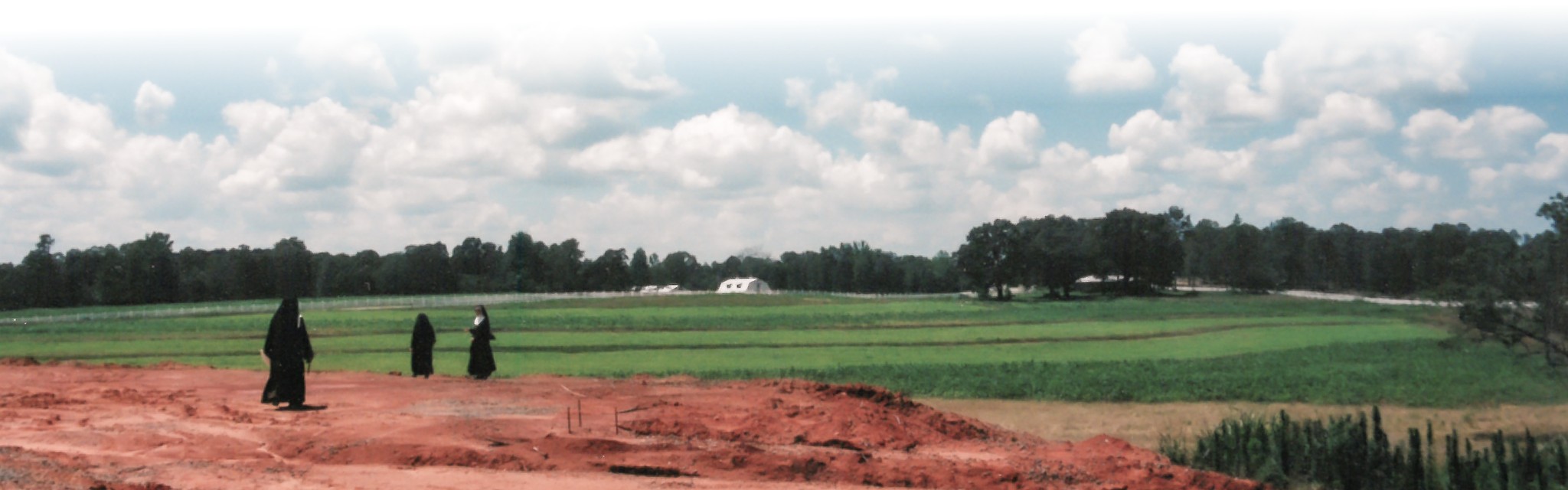
Mother Angelica founded Eternal Word Television Network (EWTN) at Our Lady of the Angels Monastery in Irondale, Alabama in 1981. As the network grew, going global on August 15, 1995, it encroached more and more on the monastery. The nuns struggled to maintain their contemplative way of life surrounded by the hustle and bustle of the television station. The cloister could also provide much needed space for EWTN’s rapid growth. So in August of 1995, just two days after the global launch, Mother began searching for land to build a new monastery.
THE “FARM” PROJECT
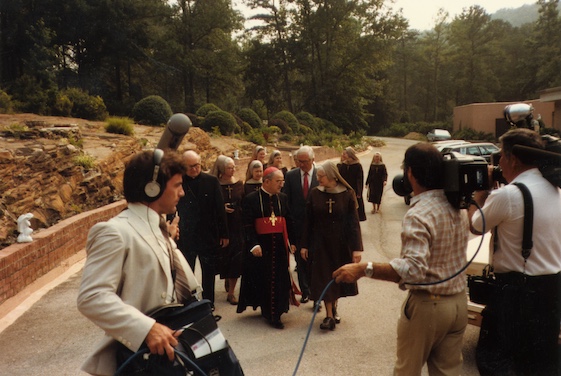
Mother Angelica scoured the Alabama countryside and on October 12, 1995, Mother’s real estate agent drove her to see a piece of property in Hanceville, AL. “I got out of the car and I knew,” Mother recounted, “ I felt the Lord’s presence so strongly. I knew this is where He wanted us.”
The land could not have been more ideal, situated in a horseshoe of the Mulberry Fork, a tributary of the Black Warrior River and surrounded by a backdrop of mountaintops. Anyone who visits the property can see right away how it is a spot truly selected by God. Mother made an offer on the property three days later, on October 15, 1995. Mother’s main intention was to build a monastery and a small farm chapel. Mother said, “My Sisters and I thought it should be very simple…”
THE DIVINE CHILD JESUS HAD DIFFERENT PLANS
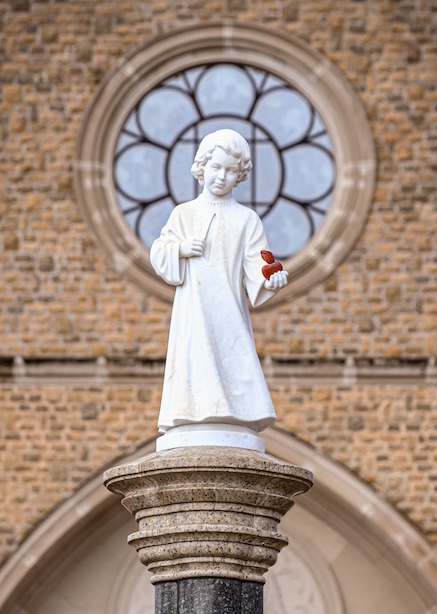
Ground had already been broken on the monastery “farm” project, when Mother traveled to South America in June of 1996 to publicize EWTN’s new Spanish channel. On her travels she visited the shrine dedicated to the Divino Nino, the Divine Child, in Colombia. While praying before this statue of the Holy Infant, it appeared to move. “All of a sudden, He turns to me,” Mother Angelica related, “and He says ‘Build me a temple and I will help those who help you.’”
A temple - that’s how plans began to change. What had started out as a private monastery and farm, began to grow into a monumental complex of European style architecture in rural Alabama.
And the money for this temple? The Christ Child had that under control too. Five separate anonymous families came forward to fund the project. These generous benefactors wanted to give the best of the best to Our Lord. No expense was spared.
“I never in my wildest dreams thought it would be so beautiful. At every turn He would change it. It got bigger and bigger, and more and more beautiful. In every possible way He intercepted our ideas and we could see what He wanted.” - Mother Angelica
"He designed it,
He built it
He paid for it."
- Mother Angelica
ONLY THE BEST FOR OUR LORD
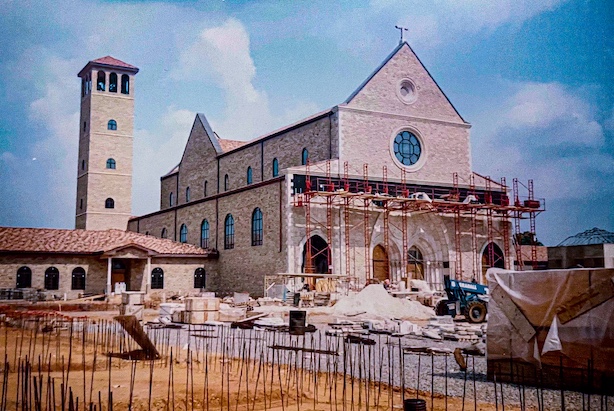
The Romanesque-Gothic architecture of both the Shrine of the Most Blessed Sacrament and Our Lady of the Angels Monastery was inspired by the great Franciscan Churches and Monasteries of the 13th Century, especially those of Assisi and the region of Umbria in Italy. The Monastery was built for durability and simple monastic living. The Shrine was designed to be as beautiful as possible, befitting the infinite dignity of God Whose House it is.
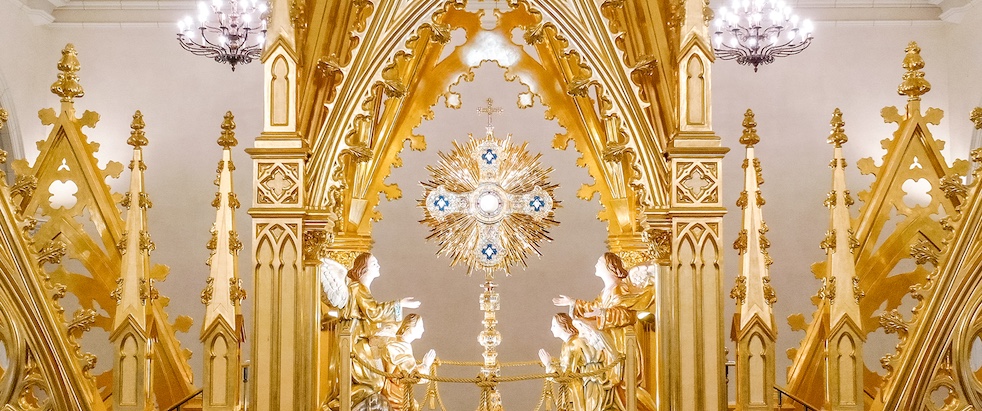
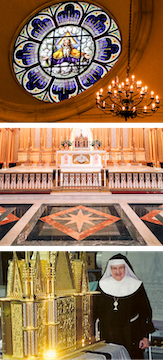
Inside the Main Church, the Sanctuary floor and Altar are made of Bianco Sivec marble from Macedonia. Behind the Altar, at the east side of the Sanctuary, is a hand-carved Reredos of rare cedar from Paraguay, 55 feet high, and ornamented with 24-carat gold leaf. This Reredos holds the gold Tabernacle and forms the Throne for the almost eight-foot Monstrance where Our Lord in the Most Blessed Sacrament is worshiped in Perpetual Adoration and Solemn Exposition. The Monstrance, Tabernacle, Reredos, Altar Rail, Crucifix, Vestry, Sacristy, Lecterns, Ambos, Confessionals, Vestibule, statues of El Divino Niño and Our Lady of Grace at the side Altars, and bronze Great Doors were all designed, constructed, and finished by Talleres de Arte Granda ("TAG") in Madrid, Spain. The Marble for the Temple floor was selected from the Carrara, Brescia, Aosta (Italian Alps), Verona, Lucca, Sicilia, and Pietrasanta regions of Italy, as well as from Macedonia (formerly Yugoslavia), Valencia in Spain, Brazil, South Africa, and Finland. Red jasper from Turkey was used for the inlaid crosses. The stained-glass windows were made by the studios of Gustav van Treeck in Munich, Germany, where they were custom-drawn, painted, and fired with the traditional Munich-style methods used for centuries by the finest Bavarian glassmakers.
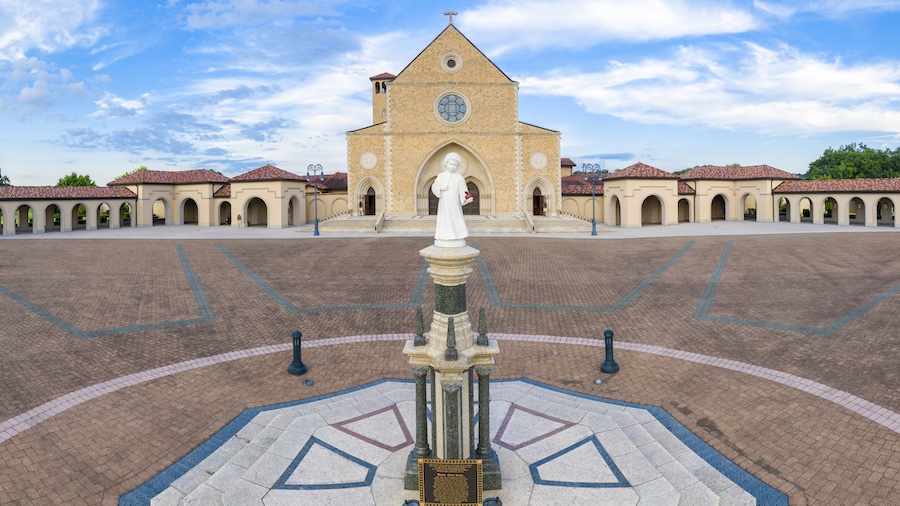
The exterior walls of the Shrine and Monastery are bricked with limestone composite bricks manufactured in Canada, a reminder of the limestone walls of the Cave of Bethlehem. The clay roof tiles of the Shrine and Monastery were molded and fired in Colombia.
The statue of the Divine Child Jesus in the Piazza was sculpted with statuary white marble from Carrara, Italy. His Heart is carved from red jasper. El Divino Niño holds His Heart in His Hand, extending an invitation to accept His Infinite Love and Mercy. The English-Tudorstyle pavers of the border of the Piazza, Colonnade, and Esplanade, and the central herringbone pattern of the Piazza, were painstakingly laid under the direction of Masonry Arts by American and Brazilian craftsmen.
THE SHRINE TODAY
The Temple and Monastery were completed in 1999 and dedicated on December 19 of that year. For the past 25 years the Shrine of the Most Blessed Sacrament has expanded to include the John Paul II Eucharistic Center, the Gift Shop of El Niño, conference rooms and the Retreat House for priests, deacons, seminarians, and religious brothers. Upkeep of the Shrine, Monastery and 400-acres of grounds are funded entirely by donations. It is only through the generous support of our benefactors and pilgrims that we are able to continue to provide a prayerful and peaceful place where people of all faiths can come and experience the Lord in the Most Blessed Sacrament of the Altar. Please consider supporting this great work of God.
“The Shrine of the Most Blessed Sacrament is a haven of peace. At this holy place, pilgrims find an oasis of spiritual renewal. The Shrine offers pilgrims a time of silence, prayer, and recollection. Adoration is the keynote of the pilgrimage to the Shrine. It truly is a new world. The graces from the perpetual Adoration are evident, bursting forth like the beams of the sun.”